Handmade Hero
About
-
C++, but using it as C.
Fun facts about Casey
-
"Knowledge I've built over 30 years, 20 years professionally".
-
He was 38 when he started making the episodes.
-
He thinks SDL is quite respectable.
-
He says he's not a game designer and really doesn't seem like a game designer.
-
He likes Functional Programming
-
"I tend to push FP when I can, but not as a dogma".
-
Likes immutability, etc., and tries to do that where possible.
-
-
If he weren't programming in C, he'd do it in Assembly.
-
"There will be no GUIs in this game".
Episodes
-
I did watch some other episodes, but I forgot to put it here.
~Ep 1 to 10 ("bootstrap", pseudo-platform layer)
-
Initial setup.
-
The introduction is very complex and deep.
-
Compilers, etc.
-
Some small off-topic bits.
-
"bootstrap" with the Windows API.
-
XInput lib for inputs.
-
DSound lib for audio.
-
Everything is done in a single script called
win32_handmade.cpp. -
"We did a lot so that we don't have to think about Windows anymore, going forwards".
-
I learned that the Windows API is terrible.
Ep 11
-
Starts with a good summary, clarifying differences when porting to different platforms, etc.
-
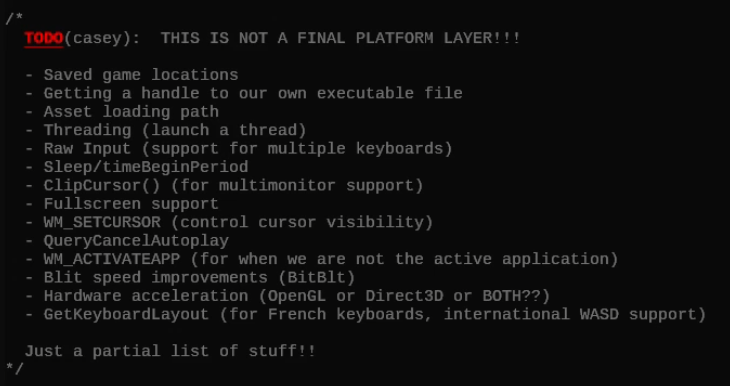
Things missing from the
win32_handmade.cppfile that will be done later:-
 .
.
-
-
{13:37 -> 31:41}
-
Great explanation and alternative for the app to be cross-platform.
-
-
{1:27:18}
-
Shows the use of "#include guards" to avoid defining things twice, so the same file isn't imported more than once.
-
-
{34:23 -> 41:45}
-
Creation of an Interface for implementing structs to be cross-platform.
-
He claims it's an Interface.
-
-
He doesn't like this approach much.
-
He says he prefers a different approach, "many-to-one".
-
Overall, I didn't fully understand the difference between this approach and the other described.
-
-
-
"There's no game in this 'platform layer', so you can use it for any game you want".
-
"I always use the same platform".
-
-
{1:27:18}
-
Shows the use of "#include guards" to avoid defining things twice, so the same file isn't imported more than once.
-
-
At the end of the video, you basically have a setup close to """"RayLib"""" / """SDL"""", finally.
Ep 26 - Game Architecture
-
Starts explaining software architecture concepts and game architecture.
-
"Until now I knew perfectly what I wanted to do, we made the Platform Layer, with Win32 and OpenGL and D3D (Direct3D), but from now on it will be a period of discoveries".
-
The game loop was planned a bit, kinda.
-
No code was written.
Ep 27
-
Draws a diagram to understand the project's state.
-
"This is basically day 1".
-
Characteristics of his game :
-
Grid-based world, but not looking like a grid.
-
"totally procedural".
-
pain :|||||||
-
-
-
"I don't have a plan on how to write those things at all".
-
He's not sure what the final version will be.
Ep 46
-
I watched the Q&A and a few things.
Ep 115 - SIMD Basics
-
Basically an explanation of "lanes" and using SOA to push data efficiently to SIMD instructions.
-
The video is about implementing SIMD using SSE/SSE2 processor intrinsics to send 4 pixels at a time to the processor instead of 1.
-
I have no idea why he's doing this; I don't know how his renderer works, so I can't say the relevance.
-
Overall, the theoretical part of the video is short, the rest is implementation and comments. The video discusses SOA / AOS and SSE/SSE2 processor intrinsics.
Ep 122 - Introduction to Multi-threading
-
{00:00 -> OS}
-
Multithreading, Processes, HyperThreading, Logical Threads, and a bit about CPU Ports.
-
-
{OS}
-
Talks about Preemption
-
It's something every modern OS uses.
-
From what I understood, it's an 'interrupt' mechanism that causes other threads from other processes to run intermittently during the execution of your code.
-
This is apparently good to be done automatically, because if it weren't, all code would always need to call
yieldto give up control.-
This is a problem if the code is buggy/poor, which can hang the whole CPU core if the OS is not preemptive.
-
-
-
-
{Heat}
-
Talks about Heat.
-
Very interesting explanation about "why isn't everything single-core? why do I need to multithread to get '100%' CPU?".
-
-
-
{The rest}
-
Just some demos of creating and joining threads. Nothing special. Skippable.
-
Ep 277 - Entity Systems
-
{10:27 -> 46:46}
-
Casey explaining Inheritance, Composition, ECS, AOS, SOA
-
"Inheritance is a compression algorithm".
-
-
He ends up moving to a Sparse Entity System design, which I found a bit suspicious and didn't like much.
Ep 441
-
The first hour of the video is him having trouble with the Nvidia site. Nothing happens.
-
The rest of the video is about Nvidia Nsight, but I didn't watch it.
Chats
Chat 7 - Inverse Kinematics
-
TLDR :
-
He doesn't show any equations or discuss any specific technique.
-
The video is basically to demonstrate the nature and difficulty of the problem.
-
-
{24:36 -> 36:50}
-
IK is an "underdetermined" system. We don't have enough equations to solve the problem; no amount of direct math will solve this.
-
Examples of artificial criteria to get out of the underdetermined system:
-
"Try to minimize movement"
-
"try to be as close as possible to the rest state"
-
"try to distribute the motion evenly among all the joints".
-
-
-
{40:19}
-
To solve: non-linear, constraints, minimization criteria:
-
Linear Complementary Solver / Lemke's Algorithm.
-
-
Needing this is not something you want to hear.
-
-
{43:04}
-
Most of the time you don't need to solve the math. It's not about getting a precise mathematical answer. You just need something that looks good.
-
-
{47:52}
-
I don't know the state of the art of an "easy" IK.
-
Then he mentions "Cyclic Coordinate Descent", but doesn't explain it.
-
Chat 11 - Undefined Behavior
-
He criticizes C and C++ a lot for how some things are not well defined, giving an incomplete solution and tool that requires you to understand all edge cases of a specification, which is absurd.
Chat 12 - Impostor Syndrome
-
Interesting.
-
He tries to be objective in judging the person's ability before making assumptions.
-
He also considers the weight of genetics.
-
{26:22}
-
Interesting exercise to find out if the problem is technique or perseverance.
-
-
{1:16:37}
-
The person gets stuck just reading tutorials.
-
The idea is to make steps and not get lost in scope.
-
Break into smaller problems.
-
Very interesting.
-
Chat 17 - Modern x64 Architecture and the Cache
Chat 18 - Shimmering artifact in Pixel Art and Nsight Shader Analysis
-
The video is incredibly useful.
-
"This is basically subpixel rendering, that's all it is".
-
{00:00 -> 45:43}
-
Use of Nvidia Nsight to reverse engineer the game Children of Morta, to try to fix the shader problems used.
-
Shows how to use Nsight a bit and comments several things.
-
The shader in Nsight is in ASM.
-
The game uses DX11.
-
He criticizes a lot the mess Unity makes.
-
-
{45:43 -> 1:21:21}
-
Diagram explanation of the problem and how to solve it.
-
{1:04:00}
-
The problem is well explained.
-
-
{1:12:00}
-
Explanation of the bilinear filtering equation.
-
-
-
{2:03:18 -> 2:13:39}
-
Analyzing and understanding this shader .
-
Chat 19 - Linear Blend, General Blend Equation, Blend for Mesh Skinning
-
{12:01 -> 21:27}
-
Explanation of linear blend.
-
(1-t) * a - t * b = c -
If the range is
[0, 1], that's interpolation.-
"We are inside 2 sample points, in a line, 'inter'".
-
-
If the range is
[-inf, +inf], that's extrapolation.
-
-
"Convex means that we stay within the boundaries we are provided".
-
"This linear blend is convex, because we are inside a line".
-
-
{45:24 -> 52:56}
-
Concludes the subject of Norm, by discussing a 'General Blend Equation'.
-
The example of the discussion comes from him drawing a pentagon, where he discusses using norm to blend between points.
-
Convex Multi-Point Blend.
-
Not solved for the pentagon case.
-
-
Norm:
-
General formula:
-
norm(g) = (a^g + b^g + c^g + ...)^(1/g)
-
-
Norm 1: Manhattan Distance.
-
a + b = c
-
-
Norm 2: Pythagoras.
-
a^2 + b^2 = c^2
-
-
-
He shows how it can be written as:
-
p' = w_0 * p_0 + w_1 * p_1 + ... + w_n * p_n-
"fmad".
-
float multiply add.
-
-
Where:
-
pare points. -
ware weights.
-
-
-
-
{52:56 -> 1:11:25}
-
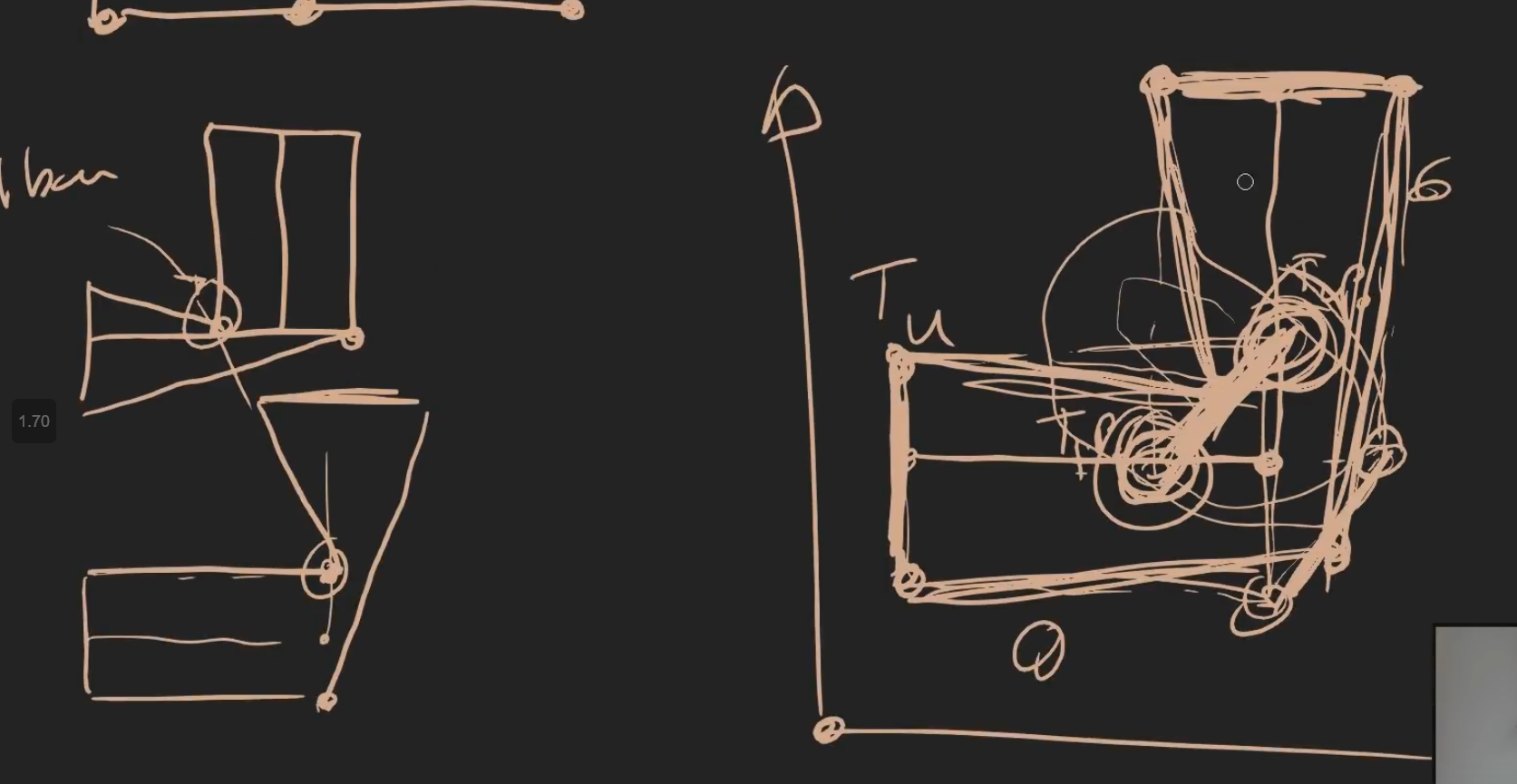
Great explanation of mesh skinning.
-
Mesh skinning is making the mesh follow the skeleton's movement.
-
On the left, without mesh skinning. On the right, with mesh skinning.
-
Without mesh skinning, some vertex must be prioritized, causing deformations that collapse faces, producing ugly visuals.
-
-
 .
.
-
All the Linear Blend explanation becomes useful here to give a nicer deformation effect on the mesh.
-
-
{1:11:25 -> 1:34:32}
-
Tricks for mesh skinning to work correctly, considering relative transforms, etc.
-
HandmadeCon
-
-
It happened in 2015 and 2016.
-
I watched Pat Wyatt's talk about networking; cool.
-