-
See Physics Engines#Theory for strategies.
-
Ex : Spin Lockless > Lockless > Sync Primitives.
-
Dedicated Threads / Static Partitioning / Domain-Specific Threads
-
Assign specific long-running tasks to fixed threads.
-
Characteristics:
-
Specialized threads (e.g., physics thread only does physics).
-
No dynamic task assignment.
-
Threads run continuously.
-
-
Used in:
-
Older game engines, embedded systems, latency-critical apps.
-
Older Unreal Engine versions: separate threads for rendering, physics.
-
-
When to Stick :
-
Game performance acceptable.
-
Stability/debug priority over throughput.
-
Workloads not easily parallelizable.
-
-
Dedicated thread may call job system for subtasks.
Pros
-
Simple to implement/debug.
-
Low latency.
-
Predictable (no unrelated contention).
Cons
-
Poor CPU utilization (idle threads waste cores).
-
Hard to scale.
Implementation
-
No Scheduler: thread manages own work manually.
-
No task queue.
Transition to: Job System
-
Technical Hurdles
-
Task Granularity: Dedicated threads handle coarse work (e.g., "whole physics step"), while jobs need fine-grained tasks (e.g., "collision check between A and B").
-
Synchronization: Dedicated threads often use locks; jobs rely on dependencies/atomics.
-
Latency Sensitivity: Jobs introduce scheduling overhead (bad for real-time threads like rendering).
-
-
Architectural Shifts
-
From "Owned Data" to "Shared Data": Dedicated threads often own their data (e.g., physics thread owns physics state), while jobs assume data is transient/immutable.
-
Debugging Complexity: Race conditions in jobs are harder to trace than linear thread execution.
-
Job System
About
-
Unit of work : task/function executed asynchronously.
-
Scheduled and managed by runtime/thread pool/scheduler.
-
Jobs require execution context and synchronization.
-
Like a thread pool but with:
-
Fine-grained tasks, dependencies, work stealing.
-
Workflow
-
A job (e.g., compute something, handle request) is created.
-
It's added to a job queue .
-
A scheduler picks jobs from the queue.
-
A worker (thread/fiber/goroutine) executes the job.
-
Synchronization primitives are used inside jobs if they access shared state.
Job or Task?
-
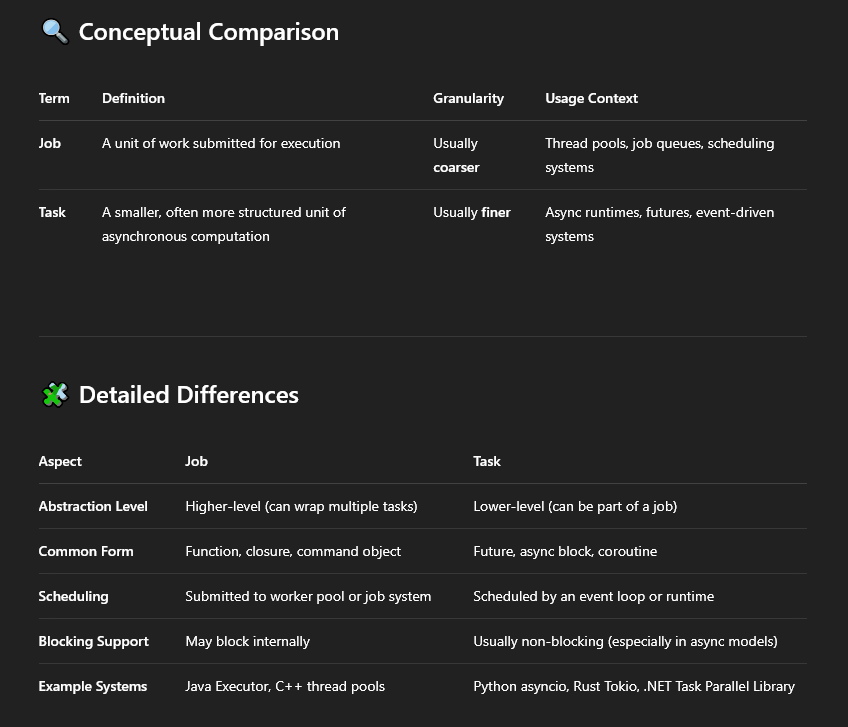
"Job is a self contained task with parameters."
-
They are closely related and often used interchangeably, but there are distinctions depending on context, level of abstraction, and language/runtime.
-
A task can be considered a specialized kind of job.
-
In many libraries and frameworks, the terms are synonymous in practice but may imply different underlying models (threaded vs. async).
-
 .
.
Job Queue
-
Is a data structure that holds pending jobs (tasks) to be executed by workers (threads, fibers, goroutines, etc.).
-
It is typically implemented as a FIFO queue, but can vary depending on scheduling strategy.
-
A buffer that stores jobs waiting to be run.
-
A job queue is often implemented using an array or linked list, with concurrency controls.
-
Tipos :
-
FIFO Queue
-
First In First Out.
-
Basic job queue, executed in submission order
-
-
Priority Queue
-
Jobs with priority levels, higher priority first
-
-
Ring Buffer
-
Fixed-size circular buffer, often for performance
-
-
Deque
-
Double-ended queue
-
-
Load-balancing / Work-stealing
-
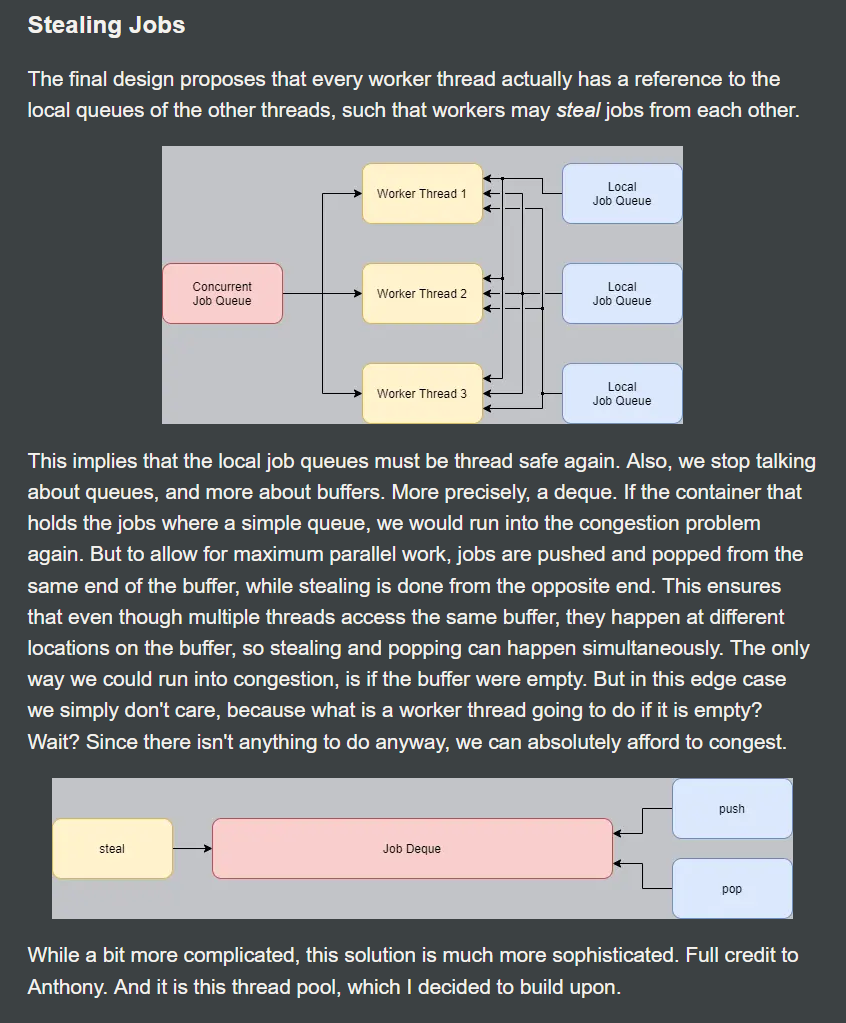
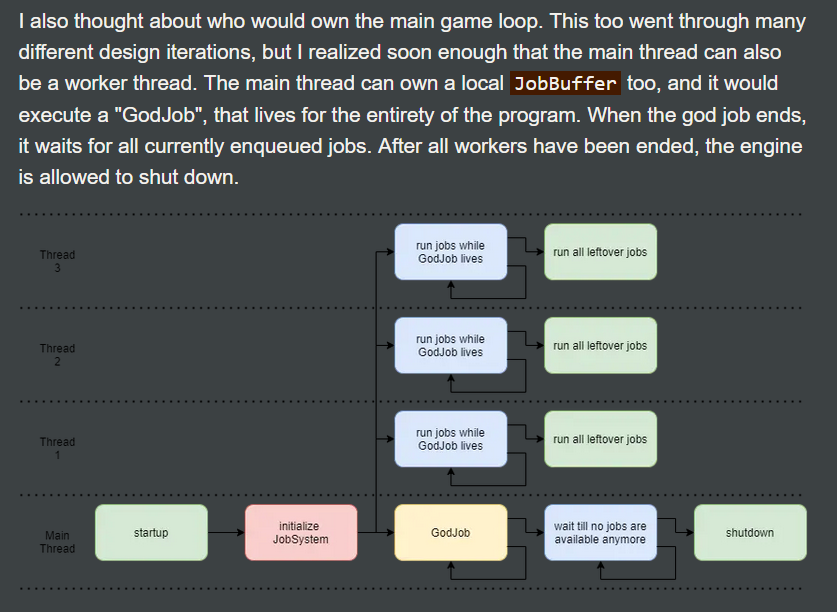
Building a Job System in Rust .
-
 .
.
-
 .
.
-
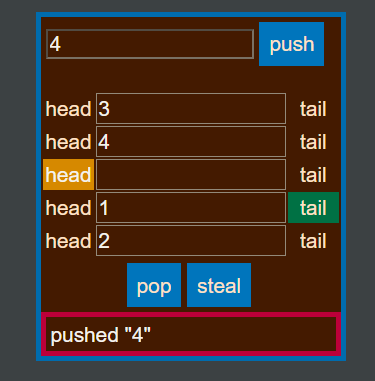
Useful to understand its Ring Buffer.
-
-
 .
.
-
"Nonetheless, I really want to do what Naughty Dog did with their engine: Jobify the entire thing. EVERYTHING will run on this job system, with a few significant exceptions: Startup, shutdown, logging and IO. Everything that runs on the job system will push local jobs."
-
-
Advantages
-
Fine-Grained Workload Distribution :
-
Jobs are small units of work, allowing better load balancing across threads.
-
Reduces idle time by keeping all threads busy with smaller tasks.
-
-
Scalability :
-
Jobs can be dynamically scheduled across available threads, scaling well with CPU core count.
-
Better suited for heterogeneous workloads than static thread partitioning.
-
-
Reduced Thread Overhead :
-
Avoids frequent thread creation/destruction by reusing a fixed pool of worker threads.
-
More efficient than per-task threading (e.g., spawning a thread for each small task).
-
-
Dependency Management :
-
Jobs can express dependencies (e.g., "Job B runs after Job A"), enabling efficient task graphs.
-
Better than manual synchronization in raw thread-based approaches.
-
-
Cache-Friendly :
-
Jobs can be designed to process localized data, improving cache coherence compared to thread-per-task models.
-
-
Flexibility :
-
Supports both parallel and serial execution patterns.
-
Easier to integrate with other systems (e.g., async I/O, game engines, rendering pipelines).
-
Disadvantages
-
Scheduling Overhead :
-
Managing a job queue and dependencies introduces some runtime overhead.
-
May not be worth it for extremely small tasks (nanosecond-scale work).
-
-
Complex Debugging :
-
Race conditions and deadlocks can be harder to debug than single-threaded or coarse-grained threading.
-
Job dependencies can create non-linear execution flows.
-
-
Potential for Starvation :
-
Poor job partitioning can lead to some threads being underutilized.
-
Long-running jobs may block others if not split properly.
-
-
Dependency Complexity :
-
While dependencies are powerful, managing complex job graphs can become unwieldy.
-
Requires careful design to avoid bottlenecks.
-
-
Latency for Small Workloads :
-
If job submission and scheduling latency is high, it may not be ideal for ultra-low-latency tasks.
-
Explanations
-
Multithreading with Fibers+Jobs in Naughty Dog engine .
-
Fibers were highly praised, it was very appreciated.
-
About libs :
-
"There are so few functions that I wouldn't bother with a library".
-
-
From what I understood of the strategy :
-
Everything is transformed into a job and scheduled to run asynchronously across multiple threads.
-
This is handled automatically by the job system.
-
All new jobs added to the queue are executed completely spread out, out of order, and with some jobs in between.
-
-
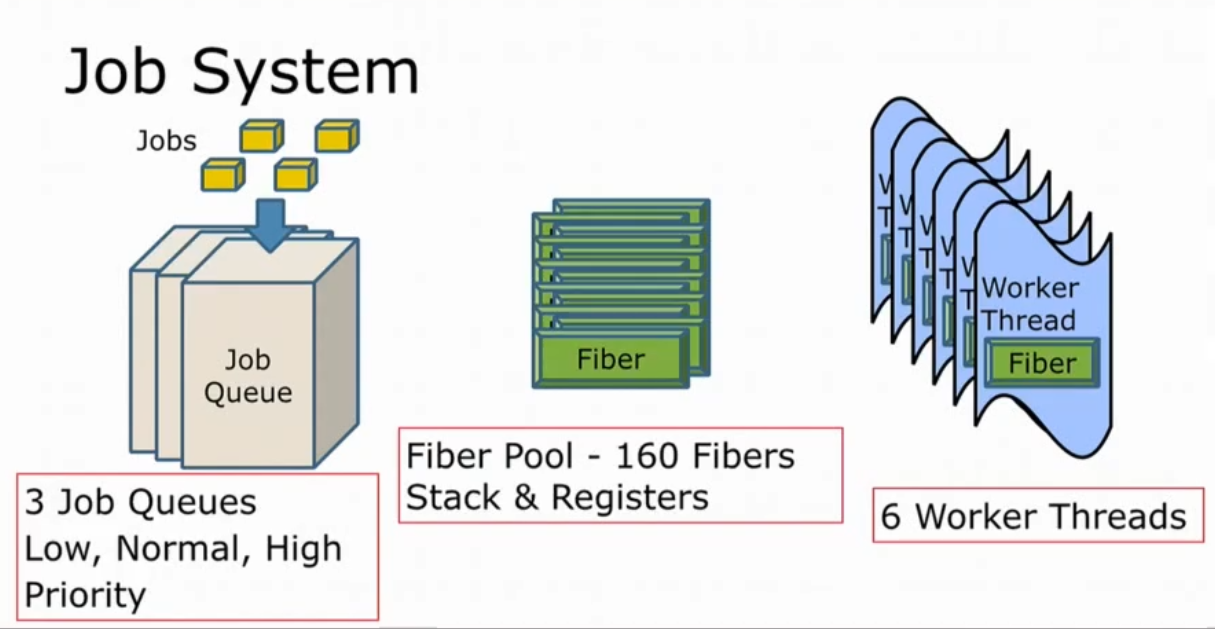
Setup :
-
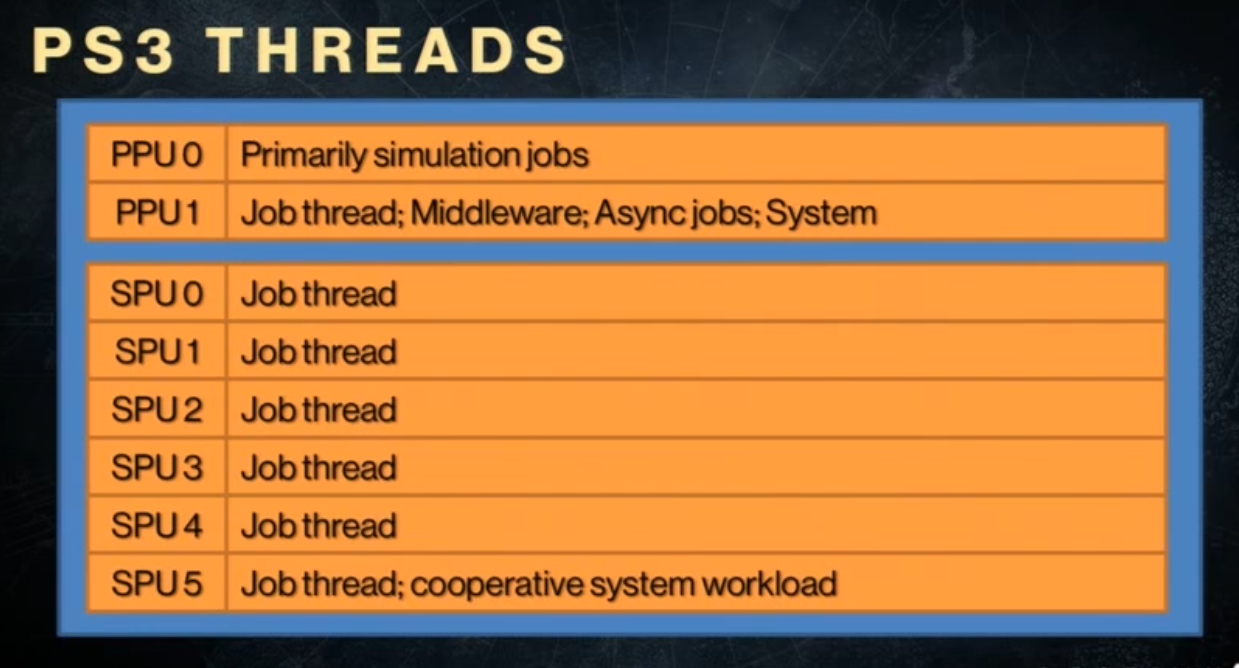
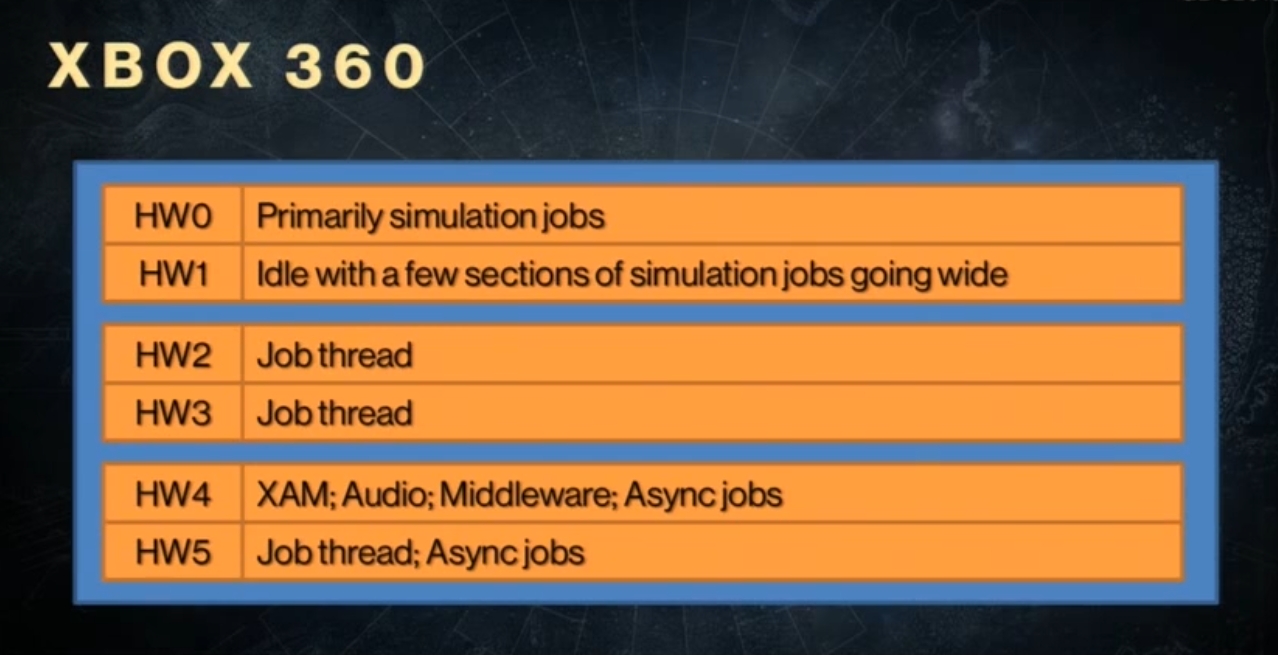
6 worker threads, one for each CPU core.
-
160 fibers.
-
800-1000 jobs per frame in The Last of Us Remastered, at 60Hz.
-
3 global job queues.
-
 .
.
-
-
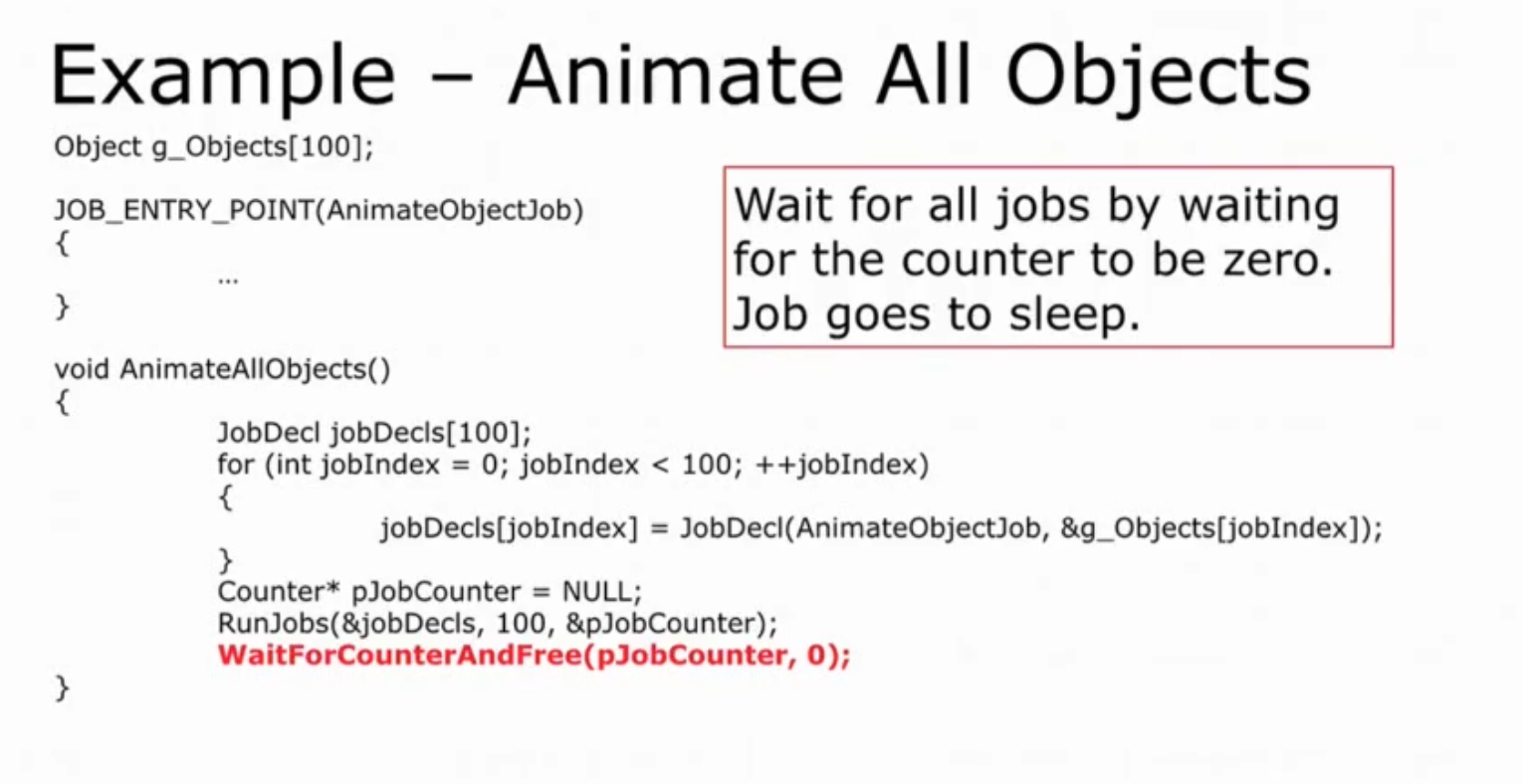
Jobs :
-
"Jobfy the entire engine, everything needs to be a job".
-
EXCEPT I/O Threads:
-
sockets, file I/O, system calls, etc.
-
"There are system threads".
-
"Always waiting (sleeping) and never do expensive processing of the data".
-
-
 .
.
-
-
Fibers :
-
"It's just a call stack".
-
Pros :
-
Easy to implement in an existing system.
-
-
Cons :
-
"System synchronization primitives can no longer be used"
-
Mutex, semaphore, condition variables, etc.
-
Locked to a particular thread. Fibers migrate between threads.
-
-
Synchronization has to be done at the hardware level.
-
Atomic spin locks are used almost everywhere.
-
Special job mutex is used for locks held longer.
-
Puts the current job to sleep if needed instead of spin lock.
-
-
-
-
Fibers and their call stacks are viewable in the debugger, just like threads.
-
Can be named/renamed.
-
Indicates the current job.
-
-
Crash handling
-
Fiber call stacks are saved in the core dumps just like threads.
-
-
"Fiber-safe Thread Local Storage (TLS)".
-
Clang had issues with this in 2015.
-
-
Use adaptive mutexes in the job system.
-
Spin and attempt to grab lock before making a system call.
-
Solves priority inversion deadlocks.
-
Can avoid most system calls due to initial spin.
-
-
-
FrameParams :
-
Data for each displayed frame.
-
Contains per-frame state:
-
Frame number.
-
Delta time.
-
Skinning matrices.
-
-
Entry point for each stage to access required data.
-
It's a non-disputed resource.
-
State variables are copied into this structure every frame:
-
Delta time.
-
Camera position.
-
Skinning matrices.
-
List of meshes to render.
-
-
Stores start/end timestamps for each stage: game render, GPU, and flip.
-
HasFrameCompleted(frameNumber) -
We have 16 FrameParams to check, but it's not 16 FrameParams worth of memory, as they are now freed.
-
"The output of one frame is the input of the next".
-
-
-
-
Written in C++.
-
 .
.
-
 .
.
-
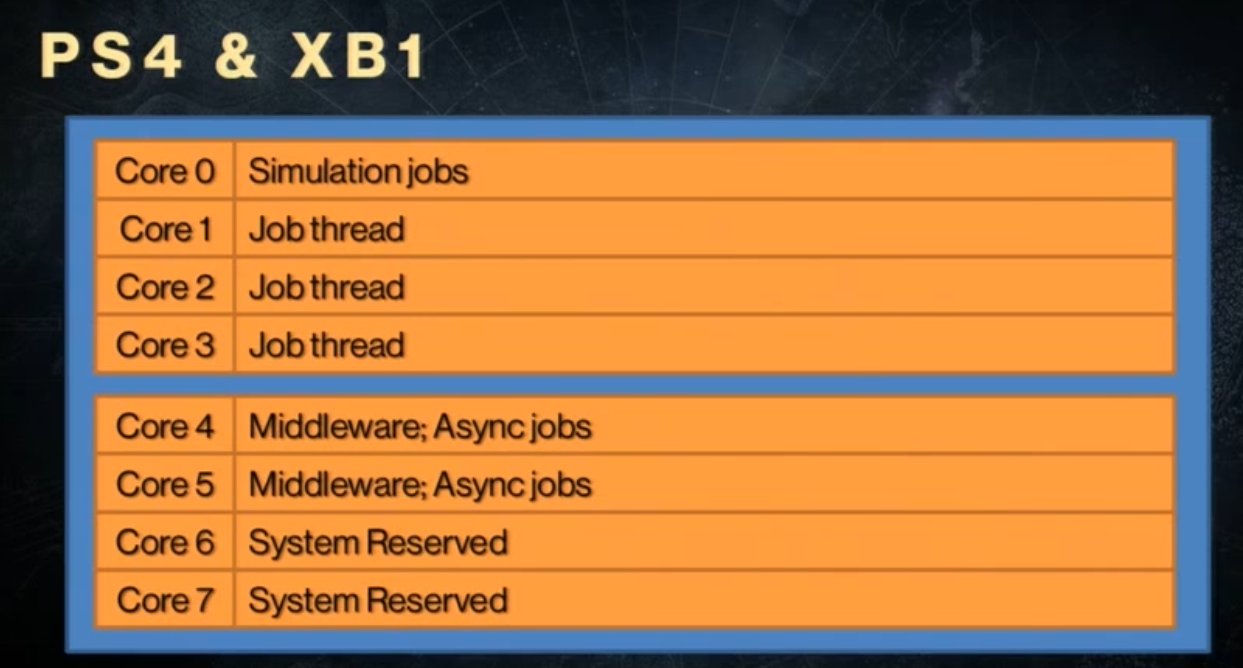 .
.
-
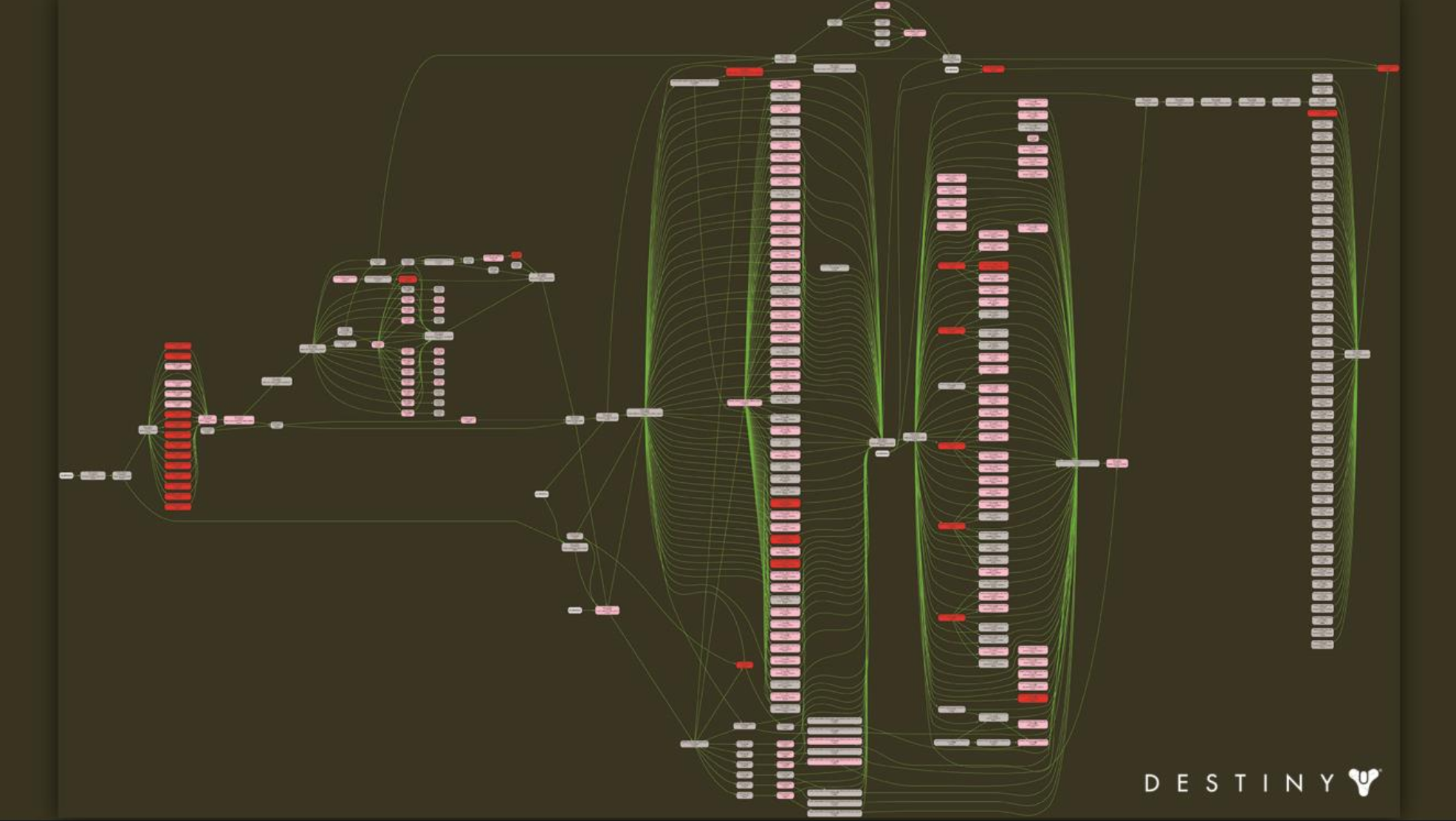 .
.
-
Jobs :
-
"Jobs with ideal duration 500us - 2000us".
-
Priority-based FIFO
-
First In First Out.
-
-
-
"" FIBER ""
-
Set of jobs that always run serially and sequentially with an associated block of memory.
-
"We have 3-4 fibers".
-
They are a convenience, as they are easier to understand than a mess of jobs.
-
"Easier to describe".
-
-
-
Resource .
-
Something that can be accessed.
-
Theoretical.
-
Havok World, player profile, AI data, etc.
-
-
Policies
-
>> Asserts << .
-
This was the biggest tip given.
-
It's an insanely difficult job, and without asserts it would be impossible.
-
-
Describe what you can do with a resource.
-
-
Handles.
-
[ ]
-
-
Resolving overlaps :
-
Add job dependencies.
-
Double buffer or cache data.
-
Queue messages to be acted upon later.
-
Restructure your algorithm.
-
{35:04 -> 38:23}
-
-
"I don't know if there were issues with the client-server architecture".
-
Job System in Unity
-
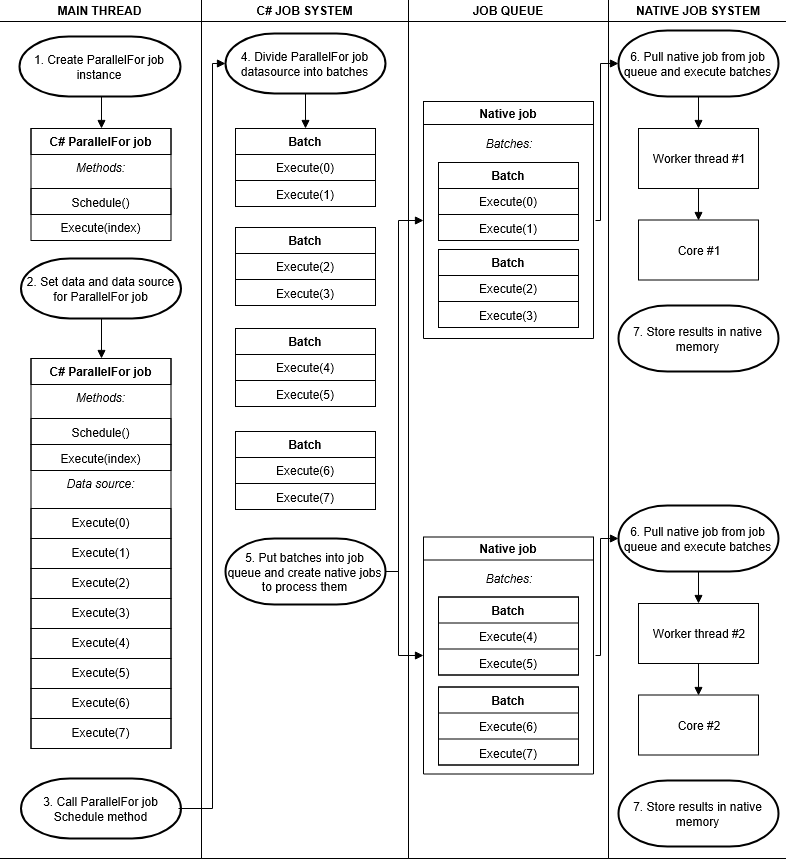 .
.
Thread Pools
-
A collection of pre-instantiated reusable threads.
-
A pool of generic threads that pull tasks from a shared queue.
-
Reduces overhead from frequent thread creation/destruction.
-
Thread pools are better than Dedicated Threads for:
-
Bursty workloads (e.g., loading screens, asset decompression).
-
Scaling across CPU cores.
-
TLDR
-
It's a middle ground between Dedicated Threads and a Job System.
-
I feel it's a "soft" version of a Job System.
-
Job systems are not strictly better than a Thread Pool—they’re more specialized.
-
Thread pools win for simplicity and low-latency tasks.
-
For most games, a hybrid approach is optimal.
-
How It Works
-
Tasks (arbitrary functions/lambdas) are pushed to a global queue.
-
Idle threads pick up tasks first-come-first-served.
-
No task dependencies (unlike job systems).
Comparisons
-
Thread Pool :
-
For simple fire-and-forget tasks (e.g., logging, file I/O).
-
-
Job System :
-
For complex, data-parallel workloads (e.g., physics, particle systems).
-
-
Stick with Dedicated Threads if:
-
Your game runs smoothly (no CPU bottlenecks).
-
You prioritize simplicity over peak performance.
-
-
Switch to Thread Pool if:
-
You have ad-hoc parallel tasks (e.g., asset loading).
-
You want better CPU usage but aren’t ready for jobs.
-
You need quick parallelism without refactoring.
-
Tasks are independent and coarse-grained.
-
You’re doing I/O or async operations.
-
-
Adopt a Job System if:
-
Your game is CPU-bound and needs max core utilization (e.g., open-world, RTS).
-
You need fine-grained parallelism (e.g., 10,000 physics objects).
-
Work has complex dependencies.
-
You’re willing to restructure code.
-
TBB / oneTBB (Threading Building Blocks)
-
It's a C++ Template Library.
-
Wiki .
-
oneTBB .
-
About .
-
Is a multithreading strategy (or more accurately, a parallel programming framework) rather than just an implementation detail of another strategy.
-
Key Points About TBB:
-
High-Level Parallelism Framework
-
TBB provides a task-based parallel programming model, allowing developers to express parallelism without directly managing threads.
-
It abstracts low-level threading details (like thread creation and synchronization) and instead focuses on tasks scheduled across a thread pool.
-
-
Not Just an Implementation Detail
-
While TBB does implement work-stealing schedulers and thread pools (which could be considered "implementation details"), it is primarily a strategy for parallelizing applications.
-
It competes with other parallelism approaches like OpenMP, raw
std::thread, or GPU-based parallelism (CUDA, SYCL).
-
-
Key Features
-
Task-based parallelism (instead of thread-based).
-
Work-stealing scheduler (for dynamic load balancing).
-
High-level parallel algorithms (
parallelfor,parallelreduce,pipeline, etc.). -
Concurrent containers (e.g.,
concurrentqueue,concurrenthashmap). -
Memory allocator optimizations
tbb::allocatorfor scalable memory allocation.
-
-
Data Parallelism
-
Same operation on different data chunks, e.g., OpenMP.
-
Data Parallelism is a strategy, but SIMD (Single Instruction Multiple Data) is an implementation detail (a CPU feature enabling it).
Actor Model
-
Independent actors messaging asynchronously.
Pipeline Parallelism
-
Split work into stages, like CPU instruction pipelines.